PAC SUN
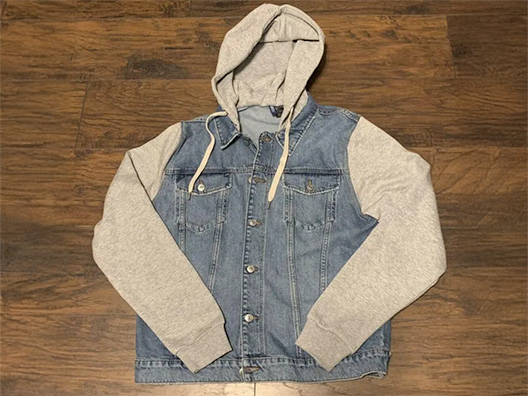
The denim jacket with cloth hood. Blue denim body, gray jersey hood, metal zipper, two chest pockets. The tag reads: 65% polyester, 30% cotton, 5% spandex. Made in Sri Lanka. $19.93, marked down from $70.00. Sun + Stone, a Macy's house brand.
The jacket has a lineage it can no longer carry. The denim body descends from the Type III Levi's trucker, itself descended from the workwear of nineteenth-century miners. From the Western shirt to James Dean to the Ramones to the man in the Brokeback Mountain poster, each generation embedded the denim jacket with a new layer of meaning, and to wear one was, at each of those moments, to make a claim. The cloth hood cancels the claim. Someone in a conference room above a factory district in Guangzhou saw the Type III silhouette on a mood board and saw the gray jersey hoodie on an adjacent mood board and proposed combining them. The garment is what comes back from the factory floor. A century of denim signification has been converted into coverage. Soft where it touches the neck, stiffer where it touches the shoulders. The claim the jacket now makes is that the weather outside is a little cool and the wearer wanted his body covered.
It is helpful, with this jacket, to remember that fashion was never the garment, but a conversation the garment was made to have with itself in three different rooms at once.21 In the first room is the real garment: the physical thing on a hanger, fabric and stitching, an object that holds heat. In the second room is the image: the same garment photographed, lit, posed against a backdrop, reduced to a flat surface of signals. In the third room is the description: the caption beneath the photograph, the runway note, the editorial paragraph that tells you what the lapel means. The three are never the same garment. The real one is warm. The image is thin. The written one is long. Fashion happens in the traffic among them. A coat becomes a coat only when the photograph and the paragraph have circulated long enough to send a shopper to the rack.
The cloth-hooded denim jacket was never properly photographed by anyone whose photographs entered the system. It was not styled in a magazine, nor did it appear in the trend forecasts that ran before the season. The Sun + Stone listing on the Macy's website carries one flat product image, lit like inventory, captioned with the words Tsunami Wash. The jacket has technically entered the language, but the system did not pick it up.

The fashion system has worked aggressively, throughout the present age, against the possibility of his owning it. The Fall 2025/Winter 2026 menswear coverage named the jacket of the year as the cropped wool blouson, or the café racer in waxed leather. The garment had been quietly retired by the trade press around 2015, after a single season at Zara and brief runs at a few other fast-fashion houses. The infrastructure of taste, having moved on, did not want him to find one. He found one anyway. Macy's, on a Saturday afternoon, two days before a club night his coworkers had organized. He needed something cleaner than the original he had been wearing for the last decade. The original was something he had bought without knowing it would become a ten-year garment that had outlasted three apartments and four phones.
The grammar of fashion was always micro-permutation.22 Two jackets identical in every respect except the collar are two different jackets. One is the executive, one is the student; or one is this season, the other is last; or one is serious, the other is playful. The meaning is in the difference the collar makes inside a system that has already decided what the alternatives are. The cloth-hooded denim jacket is the result of a permutation no system authorized: the executive's collar and the student's hoodie have been combined, and the system responds the way a grammar responds to a combination outside its rules, with silence, or with a shrug, or by reclassifying the garment as something unworthy of notice. Macy's has stocked the violation.
Subcultural style operates by bricolage.23 The mod selects the military parka, the Italian suit, the Lambretta, the soul record, and arranges them into a grammar none of them carried alone. The punk reassembles the safety pin, the bondage trouser, the dog collar into a semiotic affront that insiders read as affront and outsiders read as wreckage. The bricoleur is a maker of new sentences from borrowed words. The transgression is visible when the words still carry the memory of their original sentences. The Pac Sun Avant Garde's closet looks, to a passing observer, like bricolage. Dockers slim-fit trousers from 2008, purchased for an interview at Baskin-Robbins. A mesh On the Byas jersey with bold 00 numerals and tribal-inspired sleeve bands from PacSun, 2015, bought for Cancun. Cargo shorts from American Eagle, era indeterminate. A Pendleton wool flannel he was given at a white elephant exchange. The closet is the shape left when fifteen years of Tuesdays have deposited a pile of clothing against a wall.
The closet looks like a record of drift, and it mostly is, but the drift contains punctures. Among the Dockers and the cargo shorts hangs a single Issey Miyake pleated shirt purchased for thirty-six dollars at a consignment store in Encinitas in 2019, on an afternoon he had gone in for a belt. He has worn it twice. The shirt sits in the closet at the same weight as everything else.
To call the Pac Sun Avant Garde a passive consumer would be to describe his closet from the outside. Through retrospective analysis, his purchases are an unintentional position taken against the entire forecast. The system made its case, at full volume, for the cropped blouson. He went to Macy's and performed obscenity by buying the jacket the system had given up on. He liked the jacket and has continued to do so for a decade. He will pair it, on Saturday night, with whatever shirt was nearest the top of the drawer, which is to say with something the system did successfully place in his closet, a graphic tee absorbed in some half-remembered transaction at a mall, and the pairing will look, to anyone watching, like the casual coincidence of a man who does not think about clothes.
The accuracy of that reading is partial. While the shirt is an object of passive drift, the jacket is one of reverse osmosis. It is a faithful and complicated object, selected against the field and carried home as a trophy of specific but entirely accidental resistance against the currents of trend cycles. The Pac Sun Avant Garde walked through the 2025-2026 season and extracted the most impossible garment that could be found. The system fails through his total absorption of the specific; he consumes the lost signal and allows the remainder of the world to fall away as inert material.24
The Daoists may have called the Pac Sun Avant Garde pu 樸, referring to the piece of wood the carpenter has not yet shaped into furniture. The fashion system's labor is the carving and the sequence of operations by which raw cloth is converted into a system of signs legible to the trained reader. The cloth-hooded denim jacket sits at a stage of the work the system abandoned partway through.
The industry has a phrase for the figure it has been trying, with mixed results, to manufacture: the "intuitive dresser" or the person who dresses without reading. Stylists are hired to produce the effect on celebrities. Magazines mockup editorial spreads to instruct the reader on how to perform it. The whole apparatus is downstream of a single intuition, which is that the most desirable customer is the one who looks as though no apparatus has reached him. He is what the spreads are trying to depict. He arrived at the condition by the only path the magazines could not print, which was to have never opened the magazines.
Every act of dressing performs two motions at once25. The wearer affiliates with a group and, inside that group, distinguishes himself. One dresses in the manner of a set, and inside the set one dresses earlier, better, with more irony. Conformity, individuation: the older argument insists they are the same motion seen from two sides — and perhaps they are. The Pac Sun Avant Garde is the case in which neither motion executes. He dresses without distinction. Both engines have failed on the same morning. He goes out the door in the jacket he likes and sometimes the jacket is a suit.
The eponymous PacSun and the Pac Sun Avant Garde operate through the same logic. The Pac Sun Avant Garde shops there through a shared ontology: his, the store's and what is left of California once its ethos has flattened into shelf stock and planned cities.
Pacific Sunwear of California (Pac Sun) was founded in 1980 in Newport Beach. The origin story is the genuine article: a surf shop that made good, Southern California cool commodified and distributed to landlocked teenagers in Ohio strip malls and by the 1990s mall boom, had opened hundreds of locations. The blue-and-yellow storefronts became standard fixtures in American mall directories, their presence so ubiquitous as to become invisible. The bonfire and Toes on the Nose iconography of the early 2000s, Quiksilver, Billabong, Hurley, Volcom, Roxy, passed through PacSun on the way to becoming nostalgia. By 2010 the store had abandoned coherent identity. Its inventory became aggregation without argument: whatever licenses were available (Playboy, Nintendo, Thrasher), whatever collaborations materialized (John Galt, LA Hearts, Brandy Melville), whatever the buying team encountered at trade shows.
In the years immediately preceding the arrival of the cloth-hooded denim jacket on its hanger, PacSun began to do something stranger. In October 2022, the company announced a multi-year partnership with the Metropolitan Museum of Art.26 PacSun would now, in collaboration with the Met's curators, produce baby tees, hoodies, oversized totes, and crew socks featuring works from one of the largest art collections in the world. These included Greek and Roman sculptures in fall 2023, New York iconography in summer 2024, The Met Cloisters Holiday Collection, and a spring 2026 release drawing from rarely-seen seventeenth-to-twentieth-century works, photographed against the cliffs of Big Sur. Roman marble heads of athletes, the Three Graces, Renoir's Bouquet of Chrysanthemums were converted into screen prints and embroidery by the same factories that produced the cloth-hooded denim jacket. The Met's head of retail and licensing, in the press release, described "the enduring resonance of art." PacSun's chief merchandising officer offered his version:
"At PacSun, art is one of the core pillars of our brand and a powerful way we connect with our community. Our customer is deeply influenced by culture, and our collaboration with The Met bridges historic design with modern self-expression through style."
Both statements emerge as a corporate prose so thoroughly denatured that its language slips past the reader's resistance, asserting a perfect exactitude wherein the art object is seamlessly transfigured into merchandise. Here, the commodity itself constitutes the very site of the art's encounter with the consumer; there is no concealment, only a structural equivalence where the textual mechanics of the press release perfectly mirror the physical presentation of the retail rack.
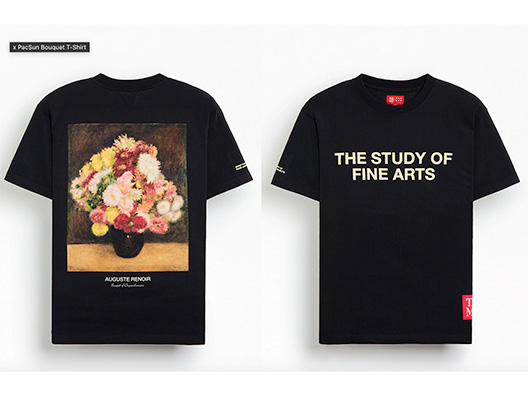
Alongside the marble heads and the chrysanthemums, PacSun also produced garments bearing only the Met's wordmark, the logo isolated against the blank field of the shirt, nearly a decade after the logo-mania of the mid-2010s had supposedly exhausted itself. The two kinds of shirt hung on the same rack on the same day. One puts a piece of art on the body. The other puts the institution that authorizes art on the body. The Met itself would announce, as the theme of its 2026 Gala, that fashion is art, and the discourse would proceed: the columns and the panels and the explainers each taking up a side of a question that had already been articulated, from opposite sides, decades earlier.27 Such a discourse relies upon maintaining a provisional distance between fashion and art, a boundary established purely to stage the spectacle of its own overcoming. Yet the retail space dispenses with this dialectical necessity, flattening the cultural hierarchy by proffering both the classical image and the institutional wordmark as simultaneous, co-equal signs available to the casual gaze of the passerby.
The website is more revealing than the rack. On pacsun.com, the Met collaboration shirts are photographed on a model whose body is at three-quarter angle, the printed artwork compressed by the fold of the fabric and partially obscured by the model's arm. The caption naming the work appears on the actual garment, beneath the image, in a small typeface; on the website the typeface is blurred to the point of illegibility. The code of the museum is overwritten by the code of commerce: the product listing names neither the painting nor the painter, but merely the size run, the price, and the fabric content. A visitor seeking to decipher what is on the shirt receives, in place of information, the shirt itself. The apparatus by which one might still operate the old question of whether fashion is art has been quietly withdrawn at the level of the catalogue, and the label that names the work is printed at a scale legible on a body, where the gaze of another wearer becomes the mirror in which the shirt finally resolves itself as a fully realized sign.
It is worth pausing on the word art and what has happened to it. For much of history art was a trade: the painter belonged to a guild and apprenticed in a workshop. The buyer commissioned a painting, a useful object that was also beautiful, like furniture. There was no ideological strain between making art and making decoration, between making art and making a living.28 This changed slowly over the nineteenth century, when the word avant-garde arrived in art criticism borrowed from military vernacular.29 The term named the small unit sent ahead of the main column to map terrain the column could not yet hold. To call an artist avant-garde in the 1820s was to make a claim about position: the artist was the unit ahead of the column—the public, the academy, the patron, the parlor.
The position became a movement and the movement became the dominant idea of what art was. The trade-and-craft tradition was renamed "decorative art" and to be a fine artist meant to negate. The collector and the curator learned to want the discomfort the artist sold, and the public arguments of the late twentieth century were arguments inside this premise. One side held the categories of art and fashion distinct. The other held that the gesture of negation had been so thoroughly absorbed by commerce that art's claim to autonomy was a fiction, in which case fashion, having always admitted its commercial life, was the more honest practice.30 The positions look opposed and share a frame: art is a category requiring a stake, requiring the line between art and not-art to be policed and crossed.
Fashion took up the avant-garde openly; the Paris runway of 1981 received a collection of asymmetrical black garments from Yohji Yamamoto who had spent the previous decade reading continental philosophy and dressing women in clothes that refused the western tailored silhouette.31 Within the next decade the style was canon; within twenty it was a uniform. The all-black palette, the dropped shoulder, the unfinished hem, the deliberate excess of fabric became the costume of a class: architects, gallerists, curators, design critics, the senior editor at the small magazine, the philosophy postdoc with the small grant. To dress in Yohji was to identify oneself, at sight, as a member of the brigade.
In November 2024, PacSun announced a 21-piece capsule with Wildside Yohji Yamamoto and Formula 1, dropping at the Las Vegas Grand Prix. The Wildside line is a diffusion line: racing-cut jackets, jersey aero tees, bucket hats, the words Yohji Yamamoto across the chest in block letters; a wordmark, sold separately, at the price of any other jacket at a mall.32
The metaphor returns to its source: fifteen minutes away from the largest Navy base on the U.S. west coast at a Westfield shopping mall. On a Saturday afternoon the Pac Sun Avant Garde buys a Wildside racing jacket and two Renoir shirts in the same size. The first is the shirt he wants. The duplicate sits on the shelf above the dresser in its plastic sleeve for an indefinite period that may be months and may be years before the original wears out. The fashion system has no language for the purchase: the garment is not collected, since to collect would be to maintain a relation to its scarcity, nor is it hoarded, since hoarding implies anxiety about supply. The mode is closer to the way the refined dresser approaches the white tee. The refined dresser has spent years in the search: the Hanes, the Uniqlo Supima, the Whitesville loopwheel, the Merz b. Schwanen 215, the four-ounce versus the seven-ounce, the boxy versus the slim, the GAT versus the tubular knit. The search terminates in a single shirt, and the shirt is purchased in quantity. The blank is the unit of a refined wardrobe, the surface against which everything else is measured, and to find the right one is to be released from the question of shirts for the foreseeable future. The Pac Sun Avant Garde performs the same operation through a different door. On a trip to Target in 2022 he picked up a navy blue T-shirt printed with a faded Captain America shield. The shirt was acquired the way most of his shirts are acquired, which is in the course of buying paper towels. He wore it twice and registered the weight and feel of the cotton as superior to most of what he owned. He drove back to the same Target the following Tuesday and bought nine more of the same shirt. By purchasing the shirt for its base meterials, “Captain America” is liberated from the shackles of intellectual property while the licensed image sits on the front of the shirt the way the tag sits on the inside: as information.
The shield itself, considered as a shape, is an exercise in the Bauhaus movement. A red circle, a white circle, a red circle, a blue circle, and a five-pointed white star at the center: the same exercise Josef Albers ran in the foundation course at Dessau, Germany with color held against color in concentric registration until the eye accepts the surface as flat. The character behind the shape was invented at Timely Comics in 1941 to sell war bonds, and the character has accumulated, in the eighty years since, a vast apparatus of plot and reference and cinematic universe. None of that apparatus survived the journey to the Target on Mission Center Road. What arrived at the rack was the shape: four concentric circles and a star, screen-printed at low fidelity onto eight ounces of cotton in Honduras. The refined dresser arrives at his blank through subtraction, paring the field of shirts down to the one that carries nothing on it. The Pac Sun Avant Garde arrives at his blank through indifference, which subtracts more thoroughly than refinement does. The character is treated as ornament and the ornament is treated as ground. The ten shirts stacked in his drawer function as undershirts, as gym shirts, as shirts to mow the lawn in, as the shirt nearest the top of the drawer on a Saturday night his cloth-hooded denim jacket requires a layer beneath it. The system had labored for eighty years to produce a sign and he had bought ten of them and used them as material.
The fashion press cannot quite address the store. Vogue does not run features on PacSun. Neither does Hypebeast. The Wildside Yohji collaboration was covered, at the time of its release, by PRNewswire — a wire service that exists to redistribute corporate announcements to other corporate employees, the press release passing from one inbox to another without ever crossing the threshold into anything a reader might encounter. The store has stopped offering the press anything to address, and the press professional has stopped trying. What the store offers instead is a literature it produces itself. In May 2026 PacSun's chief executive Brieane Olson published Co-created: The Cultural Strategy That Redefined PacSun with Simon & Schuster's Forbes imprint, a thirty-two-dollar hardcover on a cross-country tour through New Orleans, San Francisco, Miami, Washington, Boston, Los Angeles, London and Paris, culminating in a private dinner at the Metropolitan Museum of Art. The book's epilogue concerns a TikTok influencer named Lyla Biggs, whose pre-Black-Friday 2023 video featuring the company's Casey low-rise baggy jean in the Astrid wash precipitated sales of several hundred thousand pairs. The episode is offered as proof of a strategy in which legacy brands become, in Olson's phrase, "purpose-driven" by shifting their culture toward “community” and “empowering” that community through the “creator economy”. The vocabulary is the lexicon of every quarterly earnings call held in the last decade and has been thoroughly polished to the point of frictionlessness; it is language that signals competence to other speakers of the same dialect and means nothing to anyone outside the room. The Pac Sun Avant Garde will never hear it, but the book is for him, not for the “community”. It is also for the analyst at Wells Fargo, the merchandising executive three doors down at the same Westfield, the apparel-industry conference attendee in the Charlotte airport who might also own a Captain America T-Shirt he wears on Sunday afternoon outings.
The store has also begun, in the same period, to sell itself back to itself. In December 2025 PacSun launched PS Vintage, a resale platform stocked with the kinds of garment that hang on poles at flea markets in cities like Los Angeles or San Francisco: secondhand denim, vintage workwear jackets in recognizable heritage brands like Carhartt, vintage Harley-Davidson tees and fleece, and graphic tees tied to music, motorsports, and legacy brands. A Harley-Davidson tee sold at the Harley-Davidson flagship in 1999 for twenty-two dollars; resold at a vintage store in East Williamsburg in 2018 for fifty; resold at PS Vintage in 2026 for one hundred and ten and on eBay for thirty-eight. The platform expanded in April 2026 to sixteen physical stores, including the location at the Mission Valley Westfield. The divisional merchandise manager described the new section as a more curated and discovery-driven experience, organized by era, size, and style, rooted in the thrill of finding something truly one-of-a-kind. Vintage, as a fashion category, has spent the last fifteen years drifting from one definition to another. The word once denoted construction quality: a vintage jacket was a jacket made by hands that no longer made them, in fabrics that were no longer milled, with seams that no factory was now willing to pay for. The word now denotes a signal sent to other people who own vintage. The garment performs taste, knowingness, refinement, the suggestion that the wearer has access to a circulation outside the mall, a signal PacSun has detected and reproduced in a corner of the mall.
The customers the section addresses are difficult to locate. The shopper with the vocabulary to read vintage as vintage is not driving fifteen minutes from the Naval base to buy an 90’s Oxford University Graphic T shirt at the Mission Valley Westfield, he only wears 60’s vintage. The section is built for a phantom: a body that has been notified, through some downstream tributary of culture, that vintage is the thing, and who would be willing to pay one hundred and ten dollars for a faded tee provided the faded tee is presented at the rack he was already walking past, with the lighting overhead and the size-organized rail and the small printed card explaining the era. Whether this body materializes in sufficient volume to justify a sixteen-store rollout is the empirical question the rollout is, in real time, trying to answer. PS Vintage is to fashion merchandising what peanut M&Ms are to the front of an Ace Hardware: vestigial appendages designed to capture the energy of impulse.
The simulacra are doing their own work in this corner of the floor. PacSun spent the late 2010s and early 2020s printing graphic tees that simulated vintage: distressed Dr. Pepper logos, fake-faded Coca-Cola scripts, pre-rumpled Marlboro typography, screen-printed on new cotton in Bangladesh and shipped to the rack with the wear already on them. The store now stocks, on the adjacent rack, the actual Dr. Pepper tee from 1991, sourced from an estate sale in Riverside, marked at one hundred and twenty dollars. The two shirts hang within arm's reach. They are, for visual purposes, identical. The price difference is the entire content of the category. The Pac Sun Avant Garde, on the Saturday afternoon in question, walks past both racks without registering the distinction. He has, somewhere in his closet, a Billabong tee from a 2007 PacSun trip his parents took him on for back-to-school shopping, kept because it still fits and washes well. He encounters, on the floor, two Billabong shirts. The first is a 2026 reissue at the front of the store with fresh ink, fresh cotton, the original early-2000s graphic reprinted at twenty-four dollars, marketed as the "OG Billabong" capsule. The second hangs ten feet away on the PS Vintage rack, an actual surf tee from the same period, faded, in a different colorway priced at seventy-five dollars and tagged as one-of-one. He buys both. The reissue replaces the one with the hole in the hem. The vintage one will hang in the closet
The Pac Sun Avant Garde is an international phenomenon. In Seoul, the populace wears Sports Illustrated wordmarks across their chests with no relation to American sports journalism. National Geographic operates storefronts throughout South Korea selling puffer jackets to people who don't know the brand is a magazine stateside. CNN has become a lifestyle brand, its logo appearing on backpacks and bucket hats in Dongdaemun Fashion Town. These are full retail ventures at the scale of PacSun itself, with storefronts, advertising budgets, and region-specific marketing teams.33 Their editorial purposes have dissolved out of the cloth and collapsed entirely into signification. What is left is the shape itself: the red bar, the yellow rectangle, the serif of a headline font released from the institution that once owned it. The intellectual property has, once again, been freed from its captor.


The Pac Sun Avant Garde, pulling on a Budweiser tee in the opposite hemisphere, performs the same operation in reverse. The dualism is that the same gesture, repeated at scale, becomes its opposite. For him the unmoored logo is encountered as a private appreciation of a red shape, an indifference to what the red shape implies. For the Korean teenager in the National Geographic puffer, the unmoored logo has been re-anchored as uniform. He wears it as obligation with minimal interest in the scientific process or outdoor exploration. The puffer has been re-installed, on arrival, as the local sign of a coherent look one is expected to perform. The same gesture liberates the image in one body and conscripts it in another. The intellectual property escapes its first owner and is recaptured by a second order of conformity, no longer the brand's but the peer group's. What was a National Geographic magazine in 1987 becomes a square yellow shape in 2026 becomes, by Friday, a piece of the dress code at a particular high school in Jungnang-gu. The sign drifts free and is grounded again, and the difference between art and uniform turns out to be the difference between the wearer who lets the shape be just that and the wearer who needs the shape to facilitate the labor of belonging.
The Pac Sun Avant Garde is what the fashion system terminates in: American brands become Korean lifestyle accessories become American mall inventory become global commercial infrastructure. Each crossing strips another layer of original context, running the system's semiotic machinery down. The wearer is asked to supply the meaning himself, and the Pac Sun Avant Garde is the wearer who supplies a meaning the system did not anticipate, which is "I have liked this for ten years and I would like a clean one."
The architecture that contains the Pac Sun Avant Garde is the mall, which is ostensibly in decline, and ostensibly on the verge of a comeback, and both reports arrive every season without reaching him. He moves through its corridors past the Vietnamese nail salon that has been grand opening for three years, past Wetzel's Pretzels emanating its synthetic butter atmosphere, past the calendar kiosk that still exists in a world that no longer buys physical calendars. E-commerce is not an existential threat to him. He will appear at whichever commercial infrastructure replaces the mall, and absorb whichever products happen to be available, and continue to seek out, with the same unannounced determination, the few specific objects he has decided he wants. His presence is metabolic for almost everything and pointed for almost nothing, and the ratio is what makes him difficult to see.
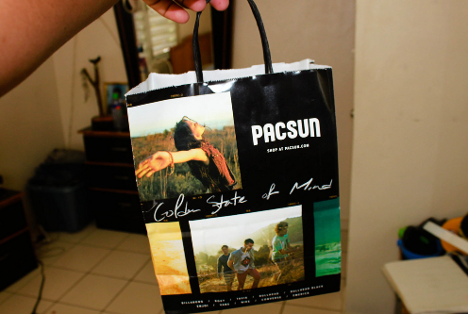
He emerges from Pac Sun and Macy's with two paper bags. The receipts are crumpled in the bag, then forgotten. The transaction leaves no psychological impact. He processes commercial culture the way the body processes air. Continuously. Unconsciously. Except for the small, almost invisible filter through which a single garment, every ten years or so, passes from the field into the closet on terms he has set himself.