1.A Southern California supermarket chain owned by Kroger. Sister chains operate under different names depending on region: Fred Meyer in the Pacific Northwest, King Soopers in Colorado, Smith's in the Mountain West, Harris Teeter in the Southeast. The international analogue is Tesco or Loblaws. Ralphs sits in the exact center of the regional grocery landscape, and is considered to be a "default" American grocery store. ↩
2.The figure is Tiqqun's, from Preliminary Materials for a Theory of the Young-Girl (1999, English 2012). Tiqqun's Young-Girl is the form of life that consumer capitalism has perfected: a subject whose interior has been wholly furnished by the market, whose desires arrive ready-priced, whose body has become a brand managed across platforms. ↩
3.Normcore was coined by the trend forecasting group K-HOLE in their 2013 PDF Youth Mode: A Report on Freedom, which proposed it as an escape from the obligation to differentiate. Within four months the fashion press had converted it from a tactic into a look. Steve Jobs's New Balance 991s appeared on Vogue.com. The argument was repurposed by exactly the system the argument was warning against. The career of the term is the argument it was making. ↩
4.Hito Steyerl (The Spam of the Earth: Withrawal from Rpresentation, 2012) argues under conditions of total algorithmic visibility, the politics of opacity is a politics of survival. The tactic presupposes a subject who can be seen and is choosing not to be. ↩
5.The chora is Plato's term, from the Timaeus, for the receptacle in which becoming takes place: a space prior to form, prior to the distinction between being and non-being. Julia Kristeva's Revolution in Poetic Language (1974) imported the term into psychoanalysis to name the pre-symbolic, pre-linguistic space of bodily drives and rhythms that the infant inhabits before language has carved out the categories of self and other. ↩
6.The structural definition of desire as the recognition of an absence belongs to Lacan, Écrits (1966), and behind Lacan to Hegel, who supplied the underlying claim that consciousness becomes self-conscious by recognizing what it lacks. The 1950s American advertising industry, having absorbed a generation of European émigré psychoanalysts including Edward Bernays (Freud's Nephew), learned to manufacture lack and to sell its momentary suturing as the function of the product. ↩
7.Sigmund Freud, Civilization and Its Discontents (1930), opens with Freud's correspondent Romain Rolland describing a feeling of limitlessness, of oneness with the universe, which Rolland identified as the religious feeling and which Freud, sceptically, named the oceanic feeling. Freud read it as a regression to an infantile state before the ego had installed its boundaries. The use being made of it here keeps Freud's structure (the dissolution of self/world boundary) and discards his pathologizing diagnosis. For the Pac Sun Avant Garde, the oceanic feeling is not a regression as there was no advance from which to regress. It is the resting state. ↩
8.Jean Baudrillard, [The System of Objects (1968)] argues consumption operates through a system in which signs are positioned relationally, so that artificial scarcity and perpetual differentiation become the engine of desire. ↩
9.The fungal turn in ecology, particularly Merlin Sheldrake's Entangled Life (2020), has popularized the observation that fungi appeared on the terrestrial environment in response to its accumulating dead matter as the metabolic answer to a problem the dead matter posed. The metabolic role precedes the metabolizing organism. ↩
10.Pierre Bourdieu, The Logic of Practice (1990). Habitus names the embodied, dispositional inheritance by which class reproduces itself through apparently spontaneous action: the way a person holds a wineglass, the music they put on at home, the temperature at which they keep their butter. ↩
11.Joan Didion mapped most of California before she died and managed to leave San Diego unmapped. Her Slouching Towards Bethlehem (1968) belongs to Sacramento, Haight-Ashbury, the Central Valley; The White Album (1979) belongs to Los Angeles and the freeway grid; her later essays belong to New York and the federal government. ↩
12.The term is Marc Augé's, from Non-Places: Introduction to an Anthropology of Supermodernity (1992). The original examples were the airport, the supermarket, the motorway service station: sites where one enters only as a contractual abstraction (ticket, receipt, barcode) and passes through without belonging. ↩
13.On the deep structure of the American strip, the canonical text is Venturi, Scott Brown, and Izenour's Learning from Las Vegas (1972), which taught architects to read the commercial vernacular of signs, parking lots, and freeway-facing storefronts as a legitimate grammar of place. The book was widely understood as a defense of vernacular taste. ↩
14.J. G. Ballard's 1964 story "The Terminal Beach" strands its protagonist on Eniwetok Atoll, a decommissioned nuclear test site in the Pacific, where he begins to live among the concrete observation blocks the Americans left behind. Historical time has halted on the atoll. The man is happier there than he was anywhere else. The terminal beach is what remains after the end of the world has failed to interestingly arrive.↩
15.Katsushika Hokusai, Under the Wave off Kanagawa (c. 1831), the first image in Thirty-six Views of Mount Fuji. The print was made late in Hokusai's career, using a Prussian blue pigment that had only recently arrived in Japan from Berlin. The little boats caught under the wave are delivery craft running fish to Edo. The poster version, often seen in college dorm rooms, tends to crop the boats out, which converts a working seascape into a landscape, which is a different image entirely. ↩
16.On the conversion of the sublime into amenity, Fredric Jameson's Postmodernism, or, The Cultural Logic of Late Capitalism (1991) argued that late capitalism dissolves the older aesthetic categories (the beautiful, the sublime, the picturesque) by making every landscape and every vantage point available as property, as view, as backdrop for the photograph that will prove someone was there. ↩
17.Jenny Holzer's Truisms (1977–79) are one-line aphorisms Holzer originally pasted anonymously around lower Manhattan and later moved onto LED tickers, benches, t-shirts, and granite slabs. The works depend on the collision of a critical utterance with a surface on which one does not expect to read criticism. ↩
18.The phrase is Jean-François Lyotard's, from Le Mur du Pacifique (1979), written while Lyotard was teaching at UC San Diego. Lyotard named California the absolute West: the place at which the westward history of states and their settlements runs out of ground and confronts an ocean it cannot cross. The Pacific Wall is invisible and therefore the most real of the walls that have been erected around the American project. ↩
19.Junkspace (Rem Koolhaas, 2002) is the air-conditioned, flowing, exit-less interior that continuous commercial expansion has produced, and the essay's own unbreathing syntax enacts the space it describes. ↩
20.Thomas Frank's The Conquest of Cool (1997) tracked the conversion of 1960s countercultural style into 1970s and 1980s advertising copy, and showed that the conversion was not a betrayal of the original but the completion of its logic: the counterculture had always been selling something, and what it sold was a newly flexible consumer subjectivity that advertising would learn to address directly. ↩
21.Roland Barthes spent three years reading Elle and Le Jardin des Modes in the basement of the École Pratique des Hautes Études, taking notes on the captions but not on the photographs. He was interested in the language and thought the photograph was already obvious. The Fashion System (1967) is the book this method produced. By the time it was published Barthes had decided he disliked the book and had moved on to writing about Japan. ↩
22.The commutation test was imported from structural linguistics, where it served as the basic tool for isolating meaningful units (phonemes, morphemes) against meaningless variation. Barthes applied it to clothing: if changing a feature of the garment changes the social meaning the garment is reading out, the feature is semantically operative; if not, it is noise. The method assumes a system of possible alternatives already in place. ↩
23.Dick Hebdige in Subculture: The Meaning of Style (1979) borrowed the term bricolage from Lévi-Strauss, who had used it to describe the mythic thinker's recombination of pre-existing elements into new ritual wholes. In Hebdige, the mod's parka and the punk's safety pin are bricolage: found objects repositioned into a semiotic guerrilla operation. Bricolage requires a bricoleur who knows what each element is for and chooses to misuse it. What looks like bricolage without a bricoleur is just a pile, except in the rare cases where one of the objects has been picked out with intention, in which case it is something the existing vocabulary, written for political subjects with manifestos, has not yet found a name for. ↩
24.The structure of this gesture is described in Jean Baudrillard, Fatal Strategies (1983), which reverses the standard logic of resistance: rather than opposing the system from the outside, the figure pushes the system's own logic past the point at which the system can recognize itself. The object becomes more object than the system can metabolize; the consumer becomes more consumer than the system can address. ↩
25.Georg Simmel in "Fashion" (1904) argued imitation and demarcation as co-constitutie drives of social life. Through imitation, the individual finds membership in a collective and is relieved of the burden of personal choice; through demarcation, fashion provides a sense of distinction and individual nuance. The "life" of a fashion depends on this tension: as soon as a trend achieves total conformity, it loses its power of distinction and ceases to be "fashion," necessitating the creation of a new form. ↩
26.The PacSun deal was brokered by Beanstalk, a licensing agency whose business is the placement of museum and entertainment IP onto consumer goods. Beanstalk also placed Met merchandise with Champion and Levi's; its other clients have included the AT&T trademark and the estates of Bob Ross and Pelé. The agency exists at the seam where the institution stops being able to handle its own commercialization and outsources the embarrassment. The Met's head of global licensing, in trade press, described the appeal of the PacSun deal as a way to give a 153-year-old institution "a bit of an edge" with the under-thirty demographic. ↩
27.Karl Lagerfeld's "art is art, fashion is fashion" and Andy Warhol's "fashion is more art than art is" are usually cited as the two poles of the question. The two of them knew each other in the 1970s. Lagerfeld appeared in Warhol's 1973 L'Amour and was photographed by him for the Polaroid archive, though he later dismissed it publicly. Warhol's project was the dissolution of the line between art and commerce, and Lagerfeld's persona (the white ponytail, the fan, the fingerless gloves) was a piece of branded image-making that could only have been produced inside the conditions Warhol had described. ↩
28.Larry Shiner, The Invention of Art: A Cultural History (2001). The argument is that the modern category of "art" — the autonomous, useless, exalted thing the museum exists to house — was assembled in the eighteenth century out of a set of older practices (painting, sculpture, music, poetry) that had previously been understood as trades. Before the consolidation, a portrait painter and a furniture maker were members of the same general professional class. ↩
29.The earliest sustained use of avant-garde in the art-critical sense is generally credited to Henri de Saint-Simon and his circle in the 1820s. ↩
30.Clement Greenberg, "Avant-Garde and Kitsch," Partisan Review 6, no. 5 (1939): 34–49, argued that once the old aristocratic and bourgeois buyers stopped supporting serious art, the avant-garde survived by turning inward and making the nature of painting itself its real subject. He defined this avant-garde against kitsch (the mass-produced, commercial, easily consumed image) which is the move that quietly exiles fashion from the category of serious art before the argument even begins, since fashion is commercial by definition and changes by season rather than by conviction. ↩
31.Yohji Yamamoto's My Dear Bomb (Japanese 2011, English 2014) is structured around the question of whether what he does is art and whether the question is the right question to ask. He answers in different directions on different pages. In one passage he insists that fashion is the lowest of the arts because it is functional and obeys the calendar. In another he describes the moment of cutting fabric as a confrontation with the impossibility of perfection that he understands to be the same confrontation a painter faces with the canvas. ↩
32.Peter Bürger's Theory of the Avant-Garde (1974) studied the historical avant-garde of the 1910s and 1920s (Dada, Surrealism, the Russian Constructivists) and his diagnosis was that the postwar neo-avant-gardes were performing the gesture without the structural condition that had once given the gesture its force. ↩
33.Doobo Shim, "Hybridity and the rise of Korean popular culture in Asia," Media, Culture & Society 28, no. 1 (2006). Shim's account of the Hallyu explains why the CNN bucket hat is not a subcultural appropriation but a commercial loop: the imported sign is hollowed on arrival, filled with a new local use, and re-exported to the culture that sent it. ↩
34.Jean Anthelme Brillat-Savarin, La Physiologie du goût (1825). Dis-moice que tumanges, je tediraice que tu es (Tell me what you eat, I will tell you what you are). Brillat-Savarin meant it as a parlor trick a clever man could perform at dinner. The marketing departments turned it into homework. ↩
35.The Lévy flight was first described in foraging behavior by physicists studying albatross GPS data in the 1990s and has since been documented in bumblebees, deer, sharks, and human hunter-gatherers. The signature property is that the distribution of step lengths has no finite variance. The largest step is always larger than any model trained on the previous steps would predict, rendering the pattern scale-invariant. These 'long tails' in probability ensure that the searcher eventually breaks from local clusters to explore distant territory which optimizes foraging efficiency when resources are sparse. ↩
36.Ziran (自然) appears throughout the Daodejing (300 BCE) as the Daoist ideal of spontaneity or "self-so-ness." It describes action that is effortless and uncontrived, standing in direct contrast to wei (為)—action driven by deliberate, self-conscious intention. While the Han dynasty saw it as a cosmic principle of non-interference, modern Mandarin uses it to mean "nature." ↩
37.At René Redzepi’s three Michelin starred Noma (Copenhagen, 2003–), diners pay roughly $750 to eat foods the kitchen staff has gathered from the Danish coastline that morning. The implicit argument is that gathering is the more authentic mode and that the modern eater has lost access to it. The medieval European peasant, who did exactly this for several centuries, considered it the food of poor people and would have been baffled by the reservation list. ↩
38.On japonisme, see Siegfried Wichmann's Japonisme (1981), which traced the nineteenth-century European appetite for the Japanese print. The current iteration runs on phone cameras and concentrates on the konbini, the vending machine, and the egg sandwich. The pattern is unchanged. A Japanese object is photographed, decontextualized, and circulated as evidence of a refinement the photographer's home country has misplaced. ↩
39.
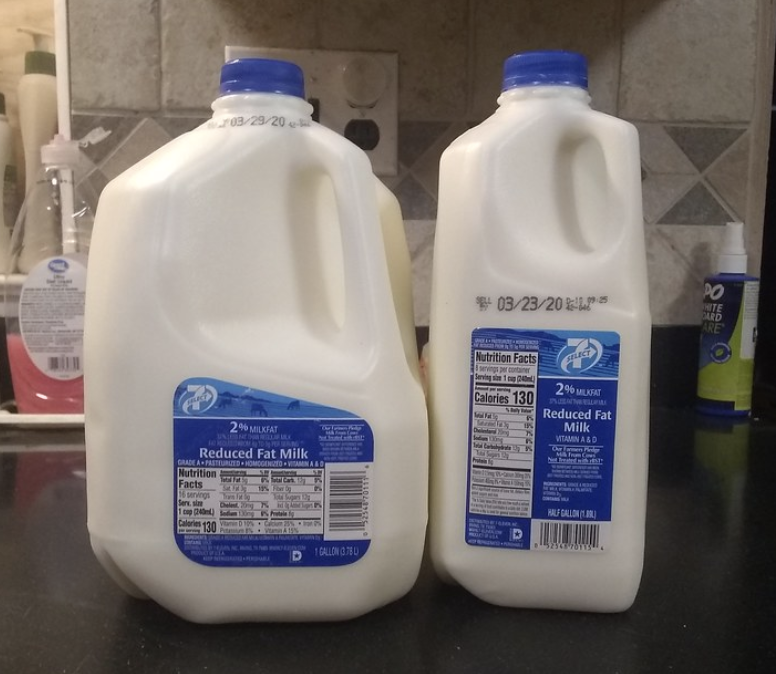
The milk that arrives at the back of the 7-Eleven cooler at 4:30 AM on a Tuesday in a refrigerated truck out of a distribution center in Vernon was produced by Holstein cows in Tulare County, in dairy operations of a scale nobody could not have imagined. Ten thousand cows in corrals stretching to the horizon. The milk moves through stainless-steel pipes from the udder to the tanker without contact with daylight. It is homogenized, pasteurized at 161° Fahrenheit for fifteen seconds, cooled, and bottled in high-density polyethylene jugs whose blow-mold tooling has not changed appreciably since the 1970s. The whole infrastructure (the genetic manipulation of the Holstein, the mechanization of milking, the interstate highway system, the electrical grid maintaining the cold chain at every point between cow and cooler) collapses, in the moment of the purchase, into a single gesture: he reaches for the jug. 7-Eleven itself began in Dallas in 1927 as an ice house, the Southland Ice Company, when ice was still being delivered to home iceboxes and the ice house was a logical place to also sell the perishables that depended on the ice. Bread, eggs, milk. The hours that gave the chain its name (7 a.m. to 11 p.m.) were a 1946 innovation, novel at the te because most grocery stores closed at six. The chain expanded, dropped the hour limits altogether in 1962 in Texas, and now operates over 85,000 stores in nineteen countries. The Japanese subsidiary acquired the American parent company in 2005. The 7Select line itself is a private-label program launched in 2009 to give the chain margin on basic groceries it had previously been buying from outside vendors. The milk in the cooler is therefore, in some technical sense, 7-Eleven's own milk, although 7-Eleven does not own dairies and the milk is contracted out to whichever regional bottler the chain has currently negotiated with. The jug itself is the latest in a sequence of milk containers each of which had a brief reign. The American urban household at the start of the twentieth century received its milk from a milkman, in glass bottles delivered to a porch box before dawn, the cap a foil disk that the housewife (the assumption was the housewife) lifted with a thumbnail. The glass bottle persisted into the 1950s in some markets and survived as a niche product into the 1970s in others. Its replacement was the gable-top paperboard carton, patented by John Van Wormer in Toledo in 1915 but not widely adopted until the 1940s, when wartime metal restrictions and improved wax coatings made the carton commercially viable. The gable-top carton has the small architectural pleasure of a roof: the consumer pries open the peak, pulls the spout outward, and pours from a folded paperboard nozzle that is almost always slightly wrong, leaking down the side of the carton on the third or fourth use. The plastic jug arrived in the 1960s, was perfected for industrial bottling in the 1970s, and is now the dominant container for fluid milk in the United States. The HDPE plastic of the 7Select jug is recyclable in principle and almost never recycled in fact. The handle is integrated into the blow-mold. The cap is a separate piece of injection-molded polypropylene, threaded onto the neck of the jug at a torque specified somewhere in a process document at the bottling plant. The price of 7select ($5.89 at the time of this publication) is a function of the unique status of milk in American consumer economics. Milk is a loss leader, a product priced at or below cost to draw shoppers into the store, the assumption being that once inside the shopper will purchase higher-margin items. The loss-leader status of milk is itself a residue of the New Deal-era dairy subsidies and the postwar mythologization of milk as essential nutrition, the Got Milk? campaign and its predecessors, a public-private alliance that produced two generations of Americans who believed without examination that milk was the cornerstone of a healthy meal. Until approximately 2005, the consequence of this arrangement was that milk in the United States was exempt from the consumer-choice burden that organized the rest of the grocery store. Most shoppers bought the same milk every week, in the same fat percentage, from the same store. The dairy aisle is now organized as a small Borgesian classification system. There is organic milk, certified by the USDA, produced without synthetic pesticides on the feed crops or routine antibiotics on the animals. There is grass-fed milk, which means the cows ate grass for some percentage of their lives, the percentage being a matter of considerable industry argument. There is A2 milk, sold on the proposition that the protein structure of certain breeds of cow is gentler on the human gut than the protein structure of the standard Holstein, the science here being thin and the marketing being heavy. There is ultra-filtered milk, branded as Fairlife and owned by the Coca-Cola Company, in which the lactose has been mostly removed and the protein concentrated. There is lactose-free milk for the lactose-intolerant. There is whole, 2%, 1%, and skim, the four-tier hierarchy that has organized the American refrigerator since the 1970s. And there is, at the outer edge of this dairy aisle and not in fact in the dairy aisle but in some adjacent shelf-real-estate the store has not quite known what to call, the wall of alternative milks: almond, oat, soy, coconut, hemp, flax, rice, pea, macadamia, hazelnut, cashew, banana, potato. None of these are milk in any sense most regulating bodies would recognize. They are emulsions of plant matter and water, sold as milk. Outside this dairy aisle, in a parallel market the FDA has spent thirty years trying to suppress, raw milk has become a quasi-religious object. The raw-milk consumer pays sixteen to twenty-two dollars a gallon for unpasteurized milk obtained directly from a small dairy, in many states through a cow-share arrangement that is the legal fiction by which the consumer notionally co-owns the cow and is therefore drinking her own milk rather than buying someone else's. The FDA explicitly warns that raw milk can carry Salmonella, Listeria, E. coli O157:H7, and Brucella, and the warnings are accurate; outbreaks occur every year. The raw-milk consumer is unmoved by this fact, believing that pasteurization is a violence done to the substance, that industrial dairy is a violence done to the cow, and that the body absorbs nutrients from raw milk in some way that pasteurization profanes. The raw-milk Facebook groups, which are private and require approval to join, are full of testimonies of healing. The position is unfalsifiable, in the sense that no quantity of scientific evidence will alter it; it has the structure of a religious commitment. ↩
40.Donna Haraway in, The Companion Species Manifesto: Dogs, People, and Significant Otherness (2003). studies the human-dog relationship as a long, mutually shaping entanglement, neither side standing apart from the other or recognizing the relation. ↩
41.In The Work of Art in the Age of Mechanical Reproduction (1935), Walter Benjamin wrote that reproduction strips the artwork of aura. The unspoken hope was that the loss might be redistributed. The actual outcome was that the loss was monetized at the level of the receipt, with the painting reduced to the occasion for the certificate of having seen it. ↩
42.Vincenzo Latronico, Perfection (Italian 2022, English 2024). Expat protagonists Anna and Tom have moved to Berlin and arranged a beautiful apartment with monstera and natural light. The novel is a satire of the late millennial tendency to live in a very curated reality. ↩
43.A small secondary economy has grown up around four-letter and dictionary-word usernames on Instagram and X (formerly Twitter), where short handles are scarce and have therefore acquired a price. Brokers maintain spreadsheets. Transfers happen through a combination of escrow services, account-recovery exploits, and quiet handshake deals on Discord and Telegram ↩
44.Aura farming entered general circulation in 2024 by way of clips from a Brazilian goalkeeper's pre-game ritual that were ironically captioned with the term and proliferated through TikTok and X. The verb farming arrives via online gaming, where it has meant, since the early 2000s in MMORPGs like World of Warcraft, the repetitive killing of low-level monsters by paid laborers in air-conditioned warehouses, who sold the resulting digital currency on secondary markets to those who did not have time to grind. The verb spread: gold farming, XP farming, karma farming, engagement farming, and now aura farming. Each names a labor that produces a resource the system was meant to distribute only as a byproduct of play. Aura was supposed to be the thing labor could not produce. There are now warehouses for it. ↩
45.This style, or something proximal to it, was dubbed #SWAG Dadaism in May 2026 on episode 156 of Nymphet Alumni (https://www.nymphetalumni.com/p/ep-156-swag-dadaism), a fashion and cultural criticism podcast. The hosts read the impulse as a generational response to global instability and technological vertigo, and as the antithesis of refinement culture. ↩
46.Freud, Character and Anal Erotism (1908), proposed that early bodily organization around retention and expulsion produced two adult character structures: one organized around holding (orderliness, parsimony, control), and one organized around its opposite (mess, generosity, refusal). Georges Bataille's The Accursed Share (1949) reread the same opposition at the scale of an economy. The question for any society in surplus is not how to produce more but how to spend what cannot be retained. The minimalist post withholds. The maximalist post deposits. They are the two solutions to the same problem and the problem is that the body has more material than the body can hold. ↩
47.Hito Steyerl, "In Defense of the Poor Image," e-flux journal 10 (2009). The poor image is Steyerl's term for the low-resolution, compressed, often pirated copy that travels fast across the internet: the bootleg film, the meme JPEG re-saved a hundred times, the news photograph screenshotted off one platform and uploaded to another. Its degradation was the price of its escape from the institutional channel that would otherwise have polished it. The essay was widely read in art school over the next decade and produced a recognizable photographic register: the flash on a pile of garbage, the off-center crop of a gas station at three a.m., the digicam shot of a friend mid-sentence with red-eye, the deliberately ugly scan, the screenshot of a screenshot. ↩
48.The phrase points at the older psychoanalytic problem of the superego, recast for contemporary conditions. Freud's superego was a prohibitive agency: do not. Lacan, in the Ethics seminar and after, identified a secondary, obscene face of the same agency, which issues the inverse command: enjoy. Slavoj Žižek and later Todd McGowan extended the reading: capitalism in its present phase has converted enjoyment from a prohibited surplus into a duty. The subject is now obligated to enjoy, to be seen enjoying, to enjoy correctly, and to post evidence of having enjoyed. Pleasure is supervised by the same apparatus that once supervised its prohibition. ↩
49.Thomas H. Ogden, "On the Concept of an Autistic-Contiguous Position," International Journal of Psychoanalysis 70 (1989), and The Primitive Edge of Experience (1989). Ogden's psychology assumes that underneath language and self-awareness there is an older layer of experience organized entirely around the senses: the weight of a blanket, the rhythm of a familiar walk, the texture of a shirt against the neck. Ogden inherits it from a tradition of child psychoanalysts (Frances Tustin in particular) who had been working with autistic children and noticed that the sensory floor, which the rest of us run underneath without noticing, was where these children spent most of their time. Ogden generalizes the observation into adult life by claiming that when this floor stays intact, the world feels textured and real. When it gets cut off from the language and image-life above it, the world starts to feel like representation: glassy, flat, somehow not quite there. The clinical category of autism itself has drifted considerably since Ogden was writing. It once named a narrow set of severe presentations in children but in the last decade, been picked up online by alienated youth as a way to circumscribe their own alienation through a letigimizing clinical category. ↩
50.The slang for the figure who has aged out of coolness has its own period (at the time of this publishing in mid 2026, it is "unc") that the body of the essay declines to record on the principle that a category that fades within eighteen months should not be archived in a footnote. ↩
51.Cold Intimacies: The Making of Emotional Capitalism (2007). Eva Illouz argued that the structures of capitalist rationality had penetrated emotional life through the forms by which emotional life was organized and expressed. To use a dating app in the intended way is to represent oneself as a finite set of “choose-able” attributes. ↩
52.Jacques Lacan's term, the “big Other”, from Écrits (1966), describes the invisible audience everyone is silently performing for: the unwritten rulebook of language and social life, the position from which one feels watched and judged even when alone in the room. What you want, in Lacan's account, is shaped from the start by what you assume this audience wants. ↩
53.Psychoanalyst Jessica Benjamin's third (The Bonds of Love, 1988) is what two people generate between themselves when they manage to actually meet: a shared space that lets each one register the other as a person rather than as an object of need. It exists in the relating between each other and has to be sustained by both parties. Her diagnosis is that trouble arrives when the third stops holding the relationship open and starts swallowing it, so that the two people end up performing for it simultaneously rather than meeting each other through it. The Tyranny of the Image names what happens when the third is swallowed in turn by the endless circulation of images, such that people relate to each other through these image rather than through one another. ↩