SAN DIEGO
The city performs an identity that evaporates the moment one tries to grasp it. The boardwalks, the fish tacos, the craft breweries, the surfboards racked outside the sandwich shop are all gestural signifiers, each one dissolving into ambience on contact with the actual city. Geography arranged this outcome with a certain irony. The phantom had to materialize here, pinned between Mexico and Los Angeles, at the thin end of the continental pipe.
The strip mall is a microcosm of adult functions: the nail salon, the vape shop, and the Kurdish dry cleaner constitute a list of things the modern citizen finds unremarkable. Beyond it, the housing tract offers a shrunken, literal memory of the Mediterranean. The beige stucco and red tile are functional masks, prefiguring a world of sidewalks that exist only as an alibi for transit.
The ocean is fifteen minutes from any point in the city. It is mostly a backdrop to justify the economics. The surfers at Tourmaline at six a.m. are praying to a god the city quietly reduces itself to metaphor: this is just a surf town after all. The god, apparently indifferent, sends waves, but also defense contractors and pharmacology graduates who will set foot on the beach maybe once yearly, in sync with their condominium's 4% increase in rent.
San Diego hardly yields easily to the essayist's grip. Joan Didion mapped most of California11 and left this stretch alone. Mike Davis lavished his attention on Los Angeles. Even Reyner Banham, who could find an ecology in any parking lot, did not write a book about it. Of all the major California cities, San Diego is the one most thoroughly absent from its own literature.
Other coastal cities yield to mythologies: Los Angeles has its noir, its freeway sublime, its industry that produces images of itself for global consumption. San Francisco has the Beat literature and the Summer of Love and the technology mythos that displaced both. San Diego has the zoo and Comic-Con and the largest concentration of active-duty Navy personnel west of Norfolk. The mythologies don't fuse but sit beside each other in the press releases.
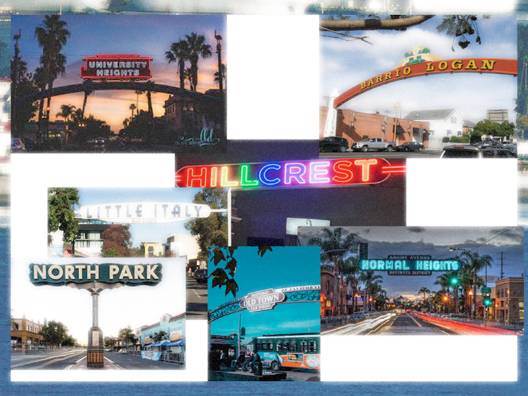
The city is a non-place12 that managed to also be where people live. The downtown is a vacancy, a site that refuses the Western metaphysical requirement for a full and gathered center. The city’s true core is at its limit, an indifferent blue expanse that forbids expansion and forces the urban movement to turn back upon itself. Hillcrest, North Park, and Normal Heights are not coherent neighborhoods but reticulated zones, disconnected fragments pinned between the freeway and the shoreline. Lacking a dense character to bleed organically into the next street, each zone requires proof of identity: large, suspended signs announcing the district like a literal postcard. This provincial feeling is stretched across seven channels of transit, each ending in the redundant plenitude of the strip mall. The overhead sign and the strip mall serve as the only "marked sites" available, offering a shrunken, explicit reality in a place devoid of a central truth. The entire city becomes a system of detours, where the driver moves through a visible form of invisibility toward a center that has evaporated into the sea.13.
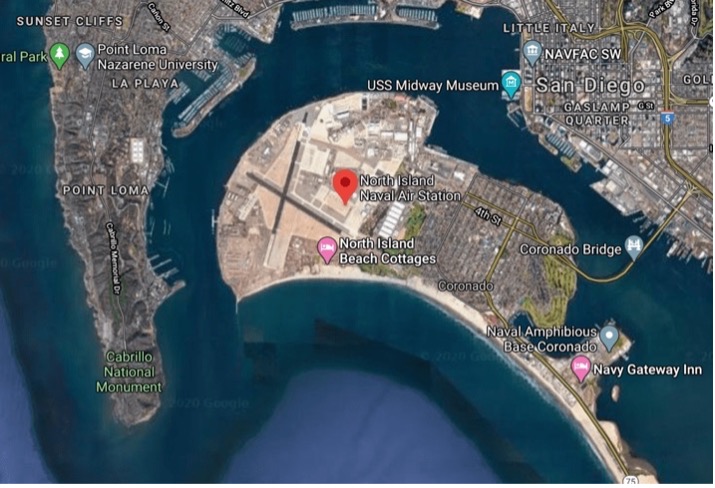
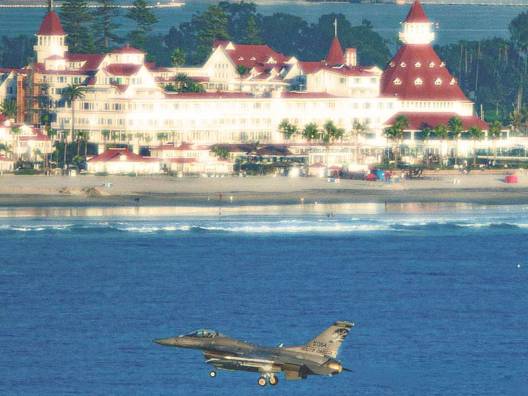
San Diego is the terminal beach14 of American culture. A perpetual middle state where time never needed to begin. The military-industrial complex achieves its most unguarded expression here in the form of casual militarism. In Coronado, a naval base shares its shoreline with luxury resorts. Aircraft carriers loom over beach volleyball courts. Navy SEALs conduct drills within view of cocktail bars. Tourists photograph warships the same way they photograph seagulls, with the same passing interest, from the same angle of cheerful distraction. The Hotel Del Coronado's Victorian turret and the Naval Amphibious Base sit in the same frame on the same coast on the same Tuesday, and no one who lives there finds this strange. The instruments of global warfare and the vacation infrastructure share a shoreline. The Pac Sun Avant Garde moves between these zones daily. Both zones register to him as climate, weight-bearing, useful. Both are flat facts of space.
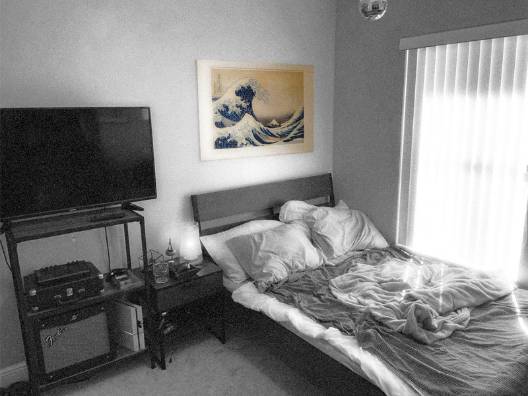
Above his bed hangs The Great Wave off Kanagawa15, the print that has colonized college dorms, cannabis dispensaries, and beachside gift shops. What the image once said about Japan's relationship to the ocean has been entirely ground off. The print now hangs as decoration, the way a framed thank-you card hangs, the way a wall calendar will hang. He bought it for $11.99 at Ross Dress for Less. He stands at Torrey Pines or Sunset Cliffs every so often, looking at the ocean the way a person looks at weather. The surfers below are obeying physical law. The waves arrive, break, recede. In San Diego the ocean has been domesticated into backdrop, amenity, property value enhancement. The sublime has metabolized into "great surfing spots," "whale watching tours," "scenic views" printed on the menus of restaurants whose entrees cost forty dollars16. The Pac Sun Avant Garde encounters the ocean without nostalgia for some imagined prior relationship to it. He absorbs the Pacific as an environmental constant, like the mild temperature, like the cycle of hunger and sleep.
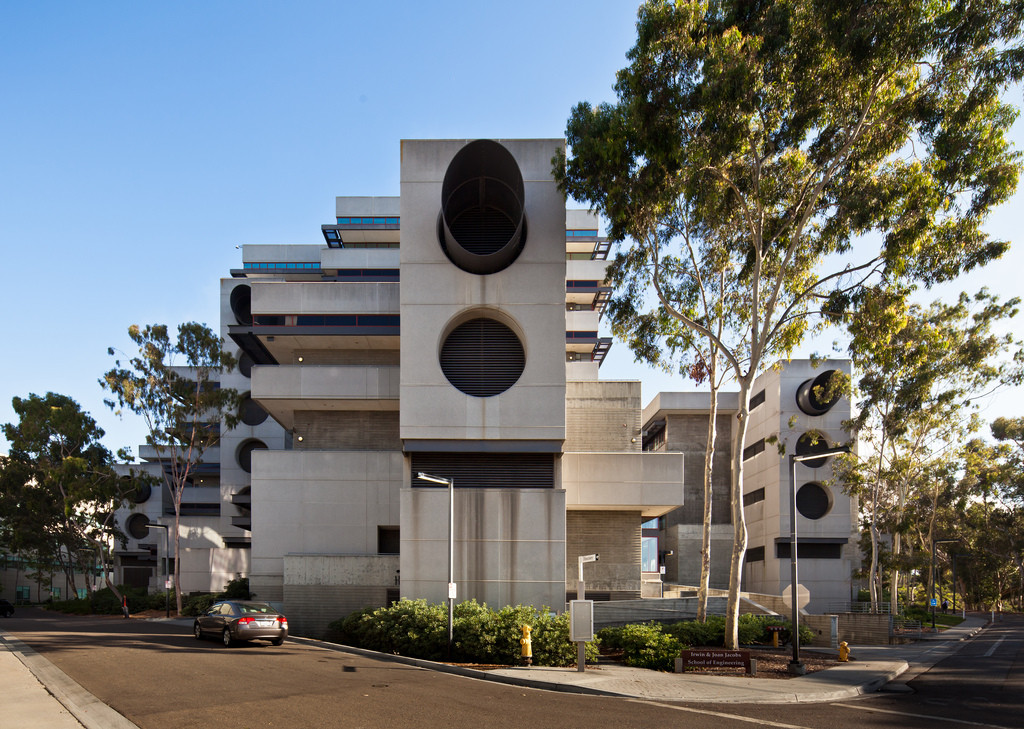
On the campus of UC San Diego is a field of modernist sculptures scattered through eucalyptus groves, assembled over decades as the Stuart Collection. Geisel Library's concrete brutalism sits on the hill like a spacecraft that stopped being interested in leaving. Do Ho Suh's Fallen Star house perches at a deliberately uncomfortable angle atop an engineering building. Jenny Holzer's Green Table sits near the Muir College quad, a massive granite slab incised with the phrase MUCH WAS DECIDED BEFORE YOU WERE BORN and other warnings from her early Truisms period17. The texts were meant to provoke existential contemplation. The table is at a convenient height. The Pac Sun Avant Garde occasionally eats his sandwich there. Students study on its surface, their textbooks covering the incised phrases; the granite holds the laptop at a good angle for typing. The critique has become furniture.
The campus sits along Torrey Pines Road. Across the street: Illumina, Pfizer, Takeda Pharmaceuticals, glass facades facing the humanities classrooms. Academia on one side of the light, its commercial application on the other. He crosses between them daily. Both buildings carry a register that precludes wonder, requiring an ID badge to enter an interior with fluorescent lighting that is at once gross and hygienic.

San Diego sits between its coastal siblings and is overshadowed by both. Los Angeles has spectacle and cultural production. San Francisco has technology and the mythology of progress. San Diego has elements of each and recognition for neither. Its biotech industry rivals the Bay in scale; the narrative of technological dominance belongs to Silicon Valley. Skateboarding was born here, in its concrete parks and empty swimming pools, through Tony Hawk and Rob Dyrdek and the whole vert ramp revolution; cultural signification of skateboarding has nevertheless migrated to Malibu and Venice. Surf culture runs deeper here in the actual daily practice of it than anywhere in California; the mythos belongs to Malibu. Comic-Con brings 130,000 people to the convention center every summer and still registers as a pilgrimage site, as visitors arriving at a stage, never at a place. The art institutions are "good enough." LA is the capital. San Diego lives at the edge of the Pacific Wall18, at the place where America's westward motion runs out of continent, and a certain flatness enters the air that no one in the city has ever learned how to complain about.
His commute is invariable. "I always take the 805 to the 5." The route established itself the first time he drove to work and has never been altered, despite Waze's suggestions of surface-street alternatives during rush hour. The notifications go unseen. Waze's algorithms register his vehicle and extract no meaningful pattern from it. His routine behavior is perfect camouflage, a form of optimization indifference that the algorithm cannot model when the model assumes an agent trying to get somewhere faster.
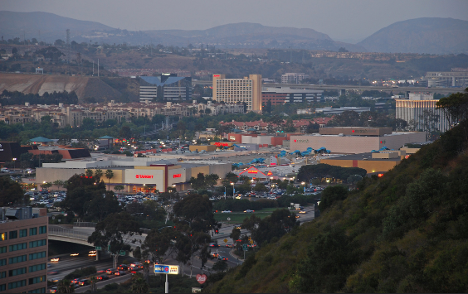
The mild weather erases the work of seasonal adjustment. He wears the same clothing year round here. Junkspace19 finds its fullest expression in San Diego's commercial infrastructure: the covered walkways connecting residential zones to commercial nodes, the parking structures floating in oceans of asphalt, the shopping complexes whose entrances dissolve into the buildings they connect. He moves through the background radiation of the leisure-military-consumer industrial complex as conductor. The strip mall is availability without commentary. Along Interstate 8, Mission Valley flattens into its own name, as the exits announce themselves: Hotel Circle North, Hotel Circle South, Qualcomm Way, Fashion Valley Road. The toponymy has surrendered: Holiday Inn, Hampton Inn, Courtyard, Residence Inn, Best Western, DoubleTree. Great Clips. Westfield. Subway. INOVA Drone Inc. Target. Jiffy Lube. Qualcomm Industries. Baskin-Robbins. Lockheed Martin RMS. Verizon. The hotel sits on Hotel Circle, and that is the whole sentence. The Pac Sun Avant Garde gravitates to San Diego where every sign declares itself completely and there is no shadow into which a second meaning might recede; the grammatical mood is indicative, present tense. The Pac Sun Avant Garde patronizes whichever business materializes along his drift path. Their distinctions are irrelevant to anything he needs, and the street agrees.

California itself is the precondition for the Pac Sun Avant Garde's existence, and San Diego is California's functional residue. The beach lifestyle that once signified rebellion has been converted into commercial infrastructure20. Revolutionary chillness has become background ambience. Rebellious nonchalance has become default setting. The taco shop called California Burritos is indistinguishable from Roberto's is indistinguishable from Rigoberto's. Each one sells the identical burrito stuffed with French fries, marketed to college students as optimal "munchies food." The Californian ethos has flattened into shelf stock. The Pac Sun Avant Garde could, in principle, materialize anywhere the California ethos has been transplanted and stripped of its spectacular elements: the sprawling developments outside Phoenix, certain zones of suburban Austin, the commercial corridors of Denver or Tampa or Charlotte. He materialized in San Diego because San Diego offered the undiluted strain.
The same flattening that converts rebellion into ambience converts the conditions for rebellion into real estate. An organic youth culture of the kind that registers as a sufficiently subcultural (Bushwick & Silverlake in the late 2000s, Neukölln in Berlin, Hackney in London) requires a few mundane inputs: cheap rent in a contiguous walkable district, density sufficient that strangers in the same age range encounter one another by accident, an oversupply of underemployed twenty-somethings, and proximity to the apparatus that will eventually photograph it. San Diego has none of these. Rent is high and dispersed across freeway distances; the population skews toward sailors, biotech postdocs, and retirees on fixed incomes; the city's mode of association is the parking lot. The Che Café has held the line at UCSD since 1980, hosting punk and hardcore shows out of a single building the university has tried to evict more than once, and it has remained, after forty-five years, a single building. It generates a scene the size of itself. San Diego has not had a moment in the way that other American cities have.
What a city in this position acquires, instead, is a developer. The state was built this way. Land is purchased before the city is; the master plan is drawn before the residents arrive; the village is designed and then a population is recruited to live inside the village. Spontaneous accumulation is the exception in California; engineered accumulation is the rule. The thing organic time would eventually have made is made in advance by an entity with capital and patience, and the residents move into a finished version of what they would otherwise have had to spend many years building.
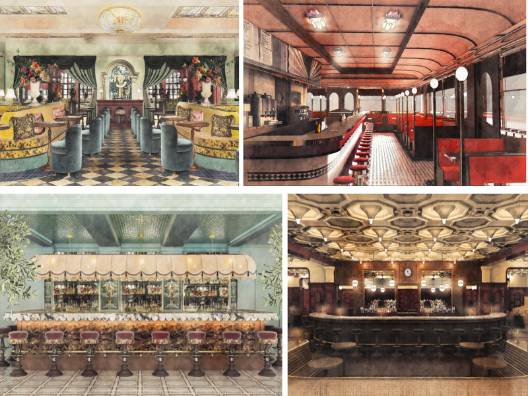
The procedure scales down to nightlife. Consortium Holdings, founded in San Diego in the late 2000s, owns roughly twenty establishments distributed across North Park and Little Italy: the Lafayette Hotel, Polite Provisions, Born and Raised, Morning Glory, Part Time Lover, False Idol, others. The firm's website explains that it does not build restaurants and bars but "public gathering spaces that help cultivate our neighborhoods through the fostering of creativity, dialogue, questions, and conversations." The tagline at the bottom of the page reads: We build environments that confront loneliness. The properties do not advertise their shared parentage; each of them performs a different aesthetic register. Polite Provisions does Victorian apothecary. Born and Raised does midcentury steakhouse. The Lafayette, reopened in 2023 after a thirty-one-million-dollar renovation, contains a hand-painted lobby ceiling, a twenty-four-hour diner serving "experimental deli food", a Oaxacan mezcalería with stained glass salvaged from a deconstructed church, and a two-lane bowling alley modeled on the Frick. A visitor moving between three of these rooms has the sensation of moving between three distinct establishments belonging to three distinct sensibilities until , in passing, the visitor realizes that the music has not changed as they went along. A server mentions that the 24/7 playlist is mandated at the corporate level and that staff is not permitted, under any circumstances, to change the tune.
This playlist is the tell. Aaliyah, the Pharcyde, Amine, Pablo-era Kanye the late-period output of a 2014 streetwear consumer who is now in his late thirties and works in marketing. The firm's mission statement insists that its goal is "neither rented nor revolutionary," that its concepts are "not about being all things to all people," that "everyone is making a conscious decision to be here." Each clause is a prophylactic against the accusation the firm has anticipated and is trying to deflect. The consciousness of the decision is the alibi which only becomes necessary when the firm has already understood that what it is selling is the resemblance of an unengineered scene.
The buildings are beautiful, and the drink selection is respectable. The art has been selected with care. What has been removed is the disorganized population that, somewhere else, would have produced these establishments by accident, in cheaper rooms, with worse cocktails, over fifteen years. The firm has compressed the period into a single year, the way one might renovate a kitchen.
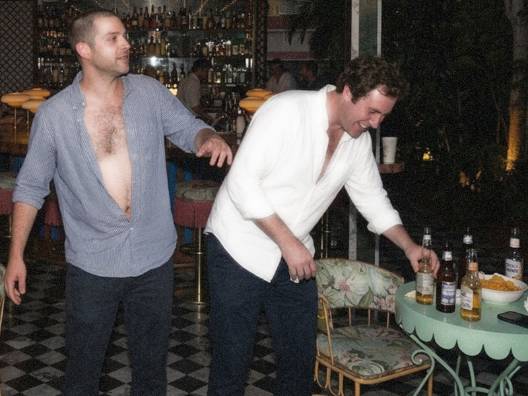
Inside any of these rooms on a Friday night, the clientele is the Pac Sun Avant Garde at the volume the establishment requires. He is wearing salmon shorts and an unbuttoned oxford. The blonde woman next to him is in a black bodycon dress from Aritzia. Neither of them registers a distinction between this room and the room at the fraternity house in Pacific Beach where the same two of them stood last Saturday. The room is dimmer here. The bartender knows what an Old Fashioned is. The crowd reads, to anyone who has spent fifteen minutes at a college bar in any state, as a college crowd. The room has been engineered to read otherwise.
The engineering was precise. The firm implicitly remodeled the Lafayette to appeal to someone specific: the man who knows which house JW Anderson is currently designing for, who can date a Japanese mill's switch to ring-spun yarn, who recognizes the salvaged glass as having come from a specific deconsecrated church in Tijuana and can place the windows within their era. Such was the man the firm projected and yet he failed to appear in the numbers the room required; indeed, one wonders whether he exists in such numbers at all, or whether he ever did.
This is where the two halves of the California gesture meet. The developer accumulates by plan; the Pac Sun Avant Garde accumulates through an aimless but ultimately earnest encounter with experience. Consortium Holdings constructs an interior that signals scarcity, taste, insider knowledge; the Pac Sun Avant Garde walks into it on a Friday because his friend's group chat picked it.
The hand-painted venetian ceiling registers as "pretty ceiling", the salvaged church glass registers as "colorful window" and the curated playlist registers as "trendy music" that is on. He likes the lighting and the drinks there. The firm has spent thirty-one million dollars producing an environment that he absorbs with the same passivity with which he absorbs the dive bar next door.
San Diego's dialectic resolves on his body. The most engineered room in the city and the least optimized consumer in the city require one another to function. The room cannot fill itself with patrons sophisticated enough to read the room; there are not enough of those patrons in the city to fill the room three nights a week. The Pac Sun Avant Garde will eventually turn thirty one and age out of the frat house. The room and the Pac Sun Avant Garde will converge. The firm has built an interior whose only sustainable customer is the customer for whom the interior is invisible. The connoisseur, had he arrived, would have spent the evening reading the ceiling. The Pac Sun Avant Garde would have been the only one who spent the evening in the room.
Geographic waste accumulates in space and in time. San Diego exists in a perpetual present. The temporal rhythms and spontaneity that structure other cities have gone missing here. Seasons blur into one long mild weather. Historical markers appear on plaques without context. Time is ambient, a background condition, a hum.
His presence in San Diego is
coincidence.
The coincidence is structural.